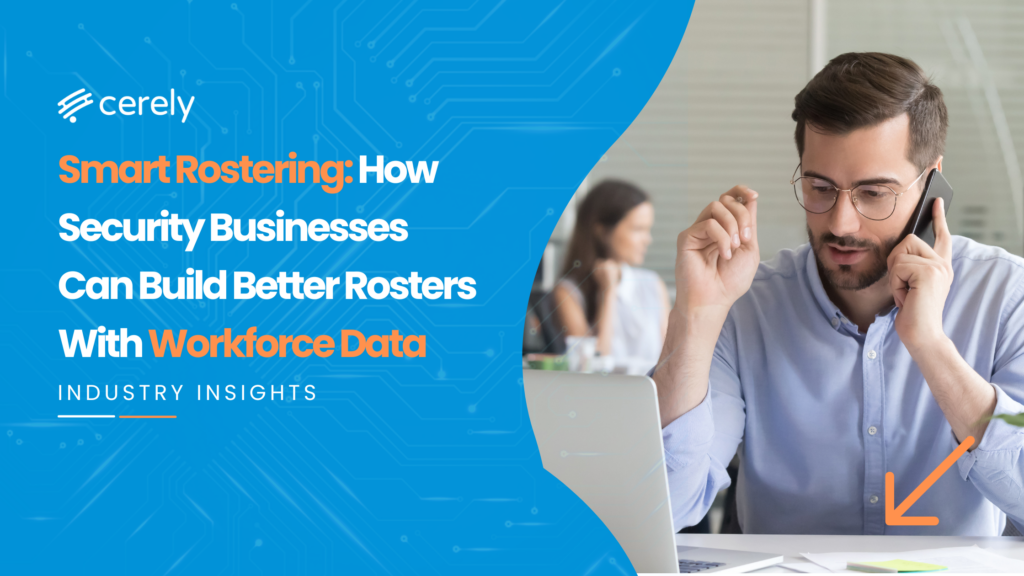
For a security business, building a roster is rarely as simple as finding someone who is available. The employee also needs to be suitable for the shift.
They may need the right security licence or qualification. They may need to meet specific client or site requirements. They need to be available at the required time. And in many cases, the roster needs to account for a complex combination of employees, sites, locations, roles and shifts.
When all of this information is managed separately, building a roster can become a time-consuming exercise in checking spreadsheets, employee files, messages and multiple systems.
It can also become heavily dependent on individual knowledge.
A roster manager may know which guards usually work at particular sites or which employees are likely to be available. But as the business grows, relying on that knowledge becomes harder to scale.
Smart rostering takes a different approach.
Instead of treating rostering as simply filling empty shifts, it uses workforce and operational data to help identify the right person for each shift.
What is smart rostering?
Smart rostering uses available workforce information and operational requirements to help determine which employees are suitable for particular shifts.
For security businesses, that can mean considering factors such as:
- Employee availability
- Security licences
- Qualifications
- Compliance requirements
- Site-specific requirements
- Role requirements
- Client requirements
- Existing roster commitments
The objective isn’t simply to automate roster creation.
It is to give operations teams better information when making deployment decisions. The right person isn’t necessarily the person who is available. They are the person who is available and meets the requirements of the shift.
The challenge with manual rostering
Manual rostering can involve a significant amount of administration. A roster manager may need to check employee availability, review qualifications, confirm compliance, look up site requirements and then determine which employees are appropriate for the shift.
If that information is stored across different systems, the process becomes even more difficult. A single shift might require multiple checks before an employee can be confidently assigned. Multiply that across dozens or hundreds of shifts and the administrative burden quickly adds up.
There is also a risk that important information can be overlooked. An employee might be available but not have the required qualification. They might be licensed but not meet a specific site requirement. Or they might normally work at a particular location but be unavailable on the day in question.
Smart rostering helps bring these considerations together.
Bringing workforce information into one place
Cerely connects rostering with the broader workforce information needed to make better deployment decisions. Employee information, availability, compliance and site requirements can be managed within the same platform.
This provides operations teams with greater visibility of the workforce.
Rather than searching through multiple sources of information, roster managers can work from a more connected view of who is:
Available. Suitable. Compliant.
That makes it easier to identify potential employees for a particular shift without relying entirely on memory or manual cross-checking.
Availability is part of the equation
Knowing whether an employee can work is fundamental to effective rostering. But determining availability manually can take time.
Operations teams may need to contact employees individually, check messages or work through separate availability records before knowing who can take a shift. Capturing employee availability within the workforce management process helps reduce this administration.
When availability information is considered alongside other workforce requirements, roster managers have a better starting point when determining who can be assigned. This becomes particularly valuable when rosters change.
An employee becomes unavailable.
A shift changes.
A client adds a requirement.
A new shift needs to be filled at short notice.
The more connected the information is, the easier it is to respond.
Compliance shouldn’t be checked separately
Availability is only one part of the rostering decision.
Security businesses also need to ensure employees meet the appropriate compliance requirements. Depending on the shift, this may involve specific licences, qualifications or other credentials.
If compliance information is managed separately from rostering, someone needs to manually check that information before assigning an employee. Cerely connects compliance information with the rostering process.
This means employee licences, qualifications and compliance requirements can be considered when determining suitability for a shift.
It helps operations teams move away from the question:
“Is this person available?”
Towards:
“Is this person available and suitable?”
Site requirements matter, too
Not every security shift has the same requirements. A particular client, site or role may require specific qualifications, credentials or other conditions.
These site-specific requirements can be configured within Cerely so they can be taken into consideration during the rostering process. This helps operations teams account for the requirements of the shift rather than relying on assumptions about which employees are appropriate.
For businesses managing multiple clients and locations, this can make a significant difference. Instead of relying on someone remembering which guards meet the requirements of each site, the relevant information can be incorporated into the rostering process.
Reducing guesswork
A good roster should be based on information rather than guesswork.
Yet manual processes can sometimes lead to decisions based on familiarity.
“That’s the guard who normally works there.”
“They’ve worked this site before.”
“They’re usually available.”
That knowledge can be useful, but it isn’t enough on its own.
Smart rostering provides a more consistent approach by bringing relevant workforce and operational information into the decision. This helps roster managers identify suitable employees based on current information rather than relying solely on individual knowledge.
Managing complex security rosters
Security businesses can have highly complex rostering requirements.
A single business might manage:
- Multiple clients
- Multiple sites
- Different locations
- Static security
- Mobile patrols
- Events
- Crowd control
- Different shift patterns
- Different role requirements
- Employees with different licences and qualifications
As the business grows, managing this complexity through spreadsheets and disconnected systems becomes increasingly difficult.
A centralised workforce management platform provides a more scalable way to manage these requirements. Cerely helps connect rostering with the workforce and operational information that supports deployment decisions.
When rosters change, information matters
Rosters are rarely static.
Employees become unavailable. Shifts change. Clients make requests. New requirements emerge.
When this happens, operations teams need to identify alternatives quickly. A connected rostering process can make this easier by helping teams determine which other employees may be suitable based on availability, compliance and site requirements.
Instead of starting the search from scratch, roster managers have more information available to help make the replacement decision. That can reduce administrative time and help operations teams respond more efficiently.
Creating a more consistent rostering process
Another benefit of smart rostering is consistency. When rostering relies heavily on individual knowledge, processes can vary depending on who is managing the roster. One person may know the workforce extremely well. Another may spend significantly more time checking records.
A connected system helps create a more consistent approach. The same types of workforce and operational information can be considered when making rostering decisions, reducing the reliance on individual memory and manual processes.
This becomes particularly important as a security business grows and more people become involved in workforce management.
Connecting rostering to the wider operation
Rostering doesn’t exist in isolation. The people assigned to shifts ultimately affect other parts of the business, including time and attendance, payroll preparation, invoicing and operational reporting.
When these functions are connected within one workforce management platform, information can flow more effectively between different parts of the operation. This helps reduce duplication and gives businesses greater visibility across the workforce lifecycle.
The roster becomes more than a schedule. It becomes part of the operational workflow.
Smart rostering is about better decisions
Smart rostering isn’t simply about creating a roster faster. It’s about making better-informed decisions about workforce deployment.
By bringing together availability, compliance, qualifications and site requirements, Cerely helps operations teams identify employees who are suitable for particular shifts. This can help reduce manual administration, minimise guesswork and support more consistent workforce deployment.
For growing security businesses, this can also provide a more scalable approach to managing increasingly complex rosters.
The right person for every shift
The ultimate goal of smart rostering is straightforward:
Put the right person, with the right availability, compliance and qualifications, into the right shift.
Cerely helps make this possible by connecting workforce information with the rostering process. Instead of relying on spreadsheets, separate systems or individual knowledge, operations teams can use connected workforce data to make more informed deployment decisions.
Because smart rostering isn’t just about filling shifts. It’s about filling them with the right people.
See how Cerely can simplify your rostering
Ready to spend less time searching through spreadsheets and manually checking employee information?
See how Cerely connects rostering with employee availability, compliance, qualifications and site requirements to help your team make faster, better-informed workforce deployment decisions.
Book a personalised demo of Cerely today.